Your Nursing Career Starts Here! – Limited Mid-Year Intake Spots Remaining

3.2 Recognise and manage an emergency situation

The ARC guidelines (Australian Resuscitation Council)  

The Australian Resuscitation Council is a voluntary coordinating body which represents all major groups involved in the teaching and practice of resuscitation. The Australian Resuscitation Council is sponsored by the Royal Australasian College of Surgeons and the Australian and New Zealand Colleges of Anaesthetists.

The Australian Resuscitation Council produces Guidelines to meet its objectives in fostering uniformity and simplicity in resuscitation techniques and terminology. 

Guidelines are produced after consideration of all available scientific and published material and are only issued after acceptance by all member organisations. This does not imply, however, that methods other than those recommended are ineffective.

The first aider should always provide first aid within the ARC recommendations and guidelines.

Managing the unconscious breathing and non-breathing casualty 

The unconsciousness is a state in which a person suddenly becomes unresponsive, unaware of their surroundings and appears to be asleep. The person can be unconscious for a few seconds or for a longer period of time. There can be different reasons for a person to suddenly become unresponsive, such as a car accident, a severe and continues blood loss, a wound in the chest or head, an overdose of a drug and alcohol poisoning. The sudden changes in the body can be the reason for temporarily unconscious state, and these causes include:

  • low brain oxygen levels
  • heart and circulation problems (e.g. fainting, abnormal heart rhythms)
  • metabolic problems (e.g. overdose, intoxication, low blood sugar) ➢ brain problems (e.g. head injury, stroke, tumour, epilepsy).

Recognition

Before losing consciousness, a person may experience yawning, dizziness, sweating, changes in skin colour, blurred vision, or nausea.

When someone collapses, assess their response to verbal and tactile stimuli (“talk and touch”). This involves giving simple commands like “open your eyes,” “squeeze my hand,” or “let it go.” Additionally, firmly squeeze their shoulders to prompt a reaction.

If the person fails to respond or only responds minimally, such as groaning without opening their eyes, manage them as if they are unconscious.

Management

If the individual is not responsive and not breathing normally, follow DRSABCD ANZCOR Basic life support flowchart

For an unconscious person who is breathing, safeguarding the airway is a priority over any potential injuries, such as spinal injuries. Handling an unconscious individual gently is crucial, avoiding any twisting or forward movement of the head and spine.

Recovery Position

An unresponsive person who is breathing should be positioned in a lateral, side-lying recovery (lateral recumbent) position instead of leaving them supine.
  1. Ensure the safety of both the individual and the rescuer.
  2. Assist the unconscious individual to the ground and place them on their side (Recovery Position), ensuring their airway remains open. Avoid leaving them sitting in a chair or positioning their head between their knees.
  3. Call for an ambulance.
  4. Stop any bleeding promptly.
  5. Continuously reassess the individual’s condition for any changes.
  6. Ideally, the most experienced rescuer should remain with the individual.
The recovery position is used for a casualty who is unconscious but breathing, or for an unconscious person who has foreign material in their airway or to help clear the airway of water after suspected drowning. It includes turning the person onto their side to keep their airway open so they can still breathe. It’s important to get help as quickly as possible for someone who’s unconscious. If another person is available, ask them to phone 000 for an ambulance. If you are alone with the casualty, turn them into the recovery position before phoning for an ambulance. The recovery position helps:
  • Maintain a clear airway – this will allow the tongue to fall forward.
  • Facilitates drainage and lessens the risk of inhaling foreign material such as food, saliva, vomit.
  • Permit good observation and access to the airway.
  • Provide a stable position and minimises the injury to the casualty.

ANZCOR guideline 3 – Recognition and first aid management of an unconscious victim

Management of foreign body airway obstruction (Choking)

Foreign objects can lead to either mild or severe blockages in the airway. 

Common indicators of choking:

  • Incident happens during eating.
  • Patient might grasp at their neck.

Signs of mild airway blockage:

Signs of severe airway blockage:

  • Patient retains ability to speak.
  • Severe coughing.
  • Difficulty breathing.
  • Patient loses ability to speak.
  • Coughing attempts produce no sound.
  • Wheezing
  • Unconsciousness

Back blows:

  • Position yourself to the side and slightly behind the patient.
  • Support the chest with one hand and tilt the patient forward.
  • Administer up to 5 forceful blows between the shoulder blades at a 90° angle using the heel of your hand.
  • Assess after each backward strike to determine if the airway obstruction has been alleviated.

Chest thrusts:

  • Locate the same compression point as for CPR.
  • Perform up to five chest thrusts, resembling chest compressions but delivered with sharper force and at a slower pace.

If the patient exhibits indications of mild airway obstruction:

  • Encourage coughing.
  • Maintain continuous observation, ready for any worsening condition.

If the patient demonstrates signs of severe airway obstruction and remains conscious:

  • Administer up to 5 back blows.
  • If back blows do not alleviate the airway obstruction, perform up to 5 chest thrusts.
  • If the obstruction persists, continue alternating between 5 back blows and chest thrusts.

If the patient loses consciousness:

  • Begin CPR.
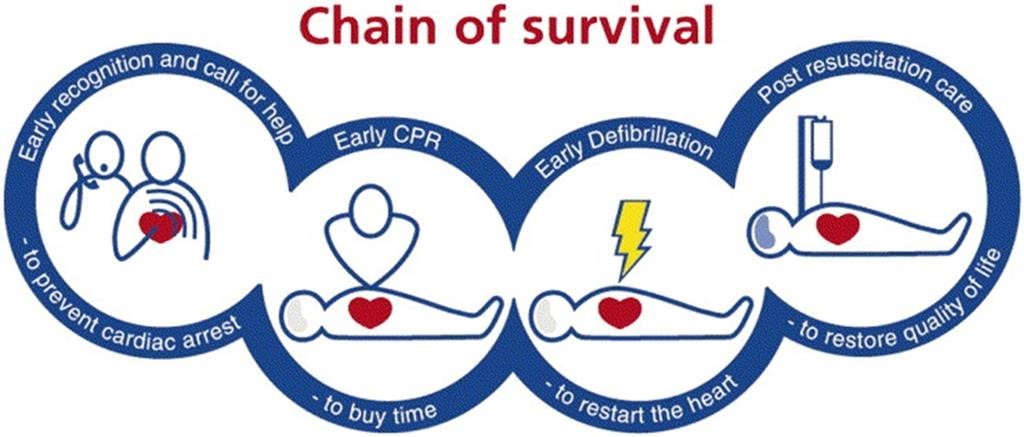
Chain of survival

Cardiovascular disease is the greatest cause of death in the adult population. The best way to increase the chance of saving sudden cardiac arrest casualties outside a hospital setting is to follow the chain of survival.

A cardiac arrest is the complete cessation of heart action recognised by the absence of response, unconsciousness and a casualty who is not breathing or not breathing normally. 

The chain of survival describes the sequence of critical intervention stages in the initial care of a cardiac arrest patient. The critical stages are:

Early call for help

It is essential to attend to the casualty and call for help as soon as possible.

Early CPR

This will increase the casualty’s chance of survival by encouraging oxygenated blood flow to the brain. 

Early defibrillation
The restoration of an adequate heart rhythm is necessary for the casualty to survive a cardiac arrest.
Post resuscitation care
Transportation of the casualty to hospital by ambulance should not be delayed enabling further treatment and monitoring of their condition.